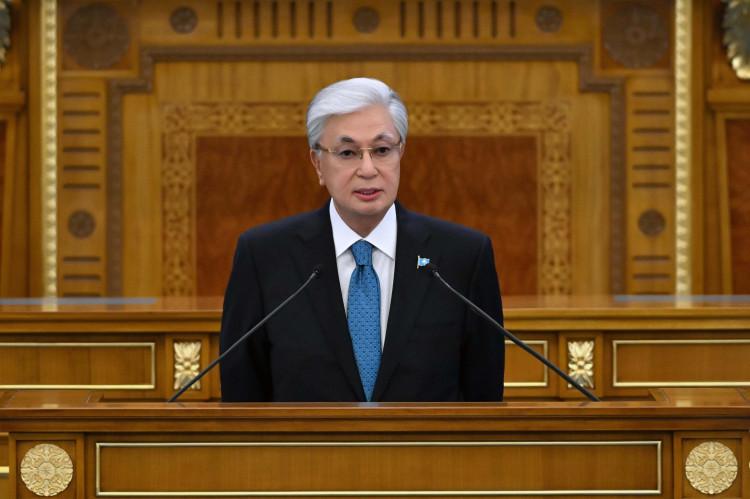

President Kassym-Jomart Tokayev has outlined an ambitious national development agenda centred on economic strength, infrastructure modernisation, investment, energy security, transport connectivity, artificial intelligence and industrial diversification, stressing that effective implementation, the rule of law and national unity are essential to Kazakhstan’s long-term progress.
The priorities were set out in his 2026 State of the Nation Address, titled “Kazakhstan’s Current Priorities in a New Historical Cycle,” as the country marks 35 years of independence and implements its new Constitution, which entered into force on July 1, 2026.
President Tokayev announced the launch of Halyqtyq Qurylys, or “People’s Construction,” described as the largest infrastructure programme in Kazakhstan’s history, and proposed designating 2027 as the Year of Nationwide Large-Scale Construction.
The programme will cover social infrastructure, transport, utilities and housing across all regions, with the Government tasked with preparing a region-by-region project list by the end of 2026.
Around 6.5 trillion tenge, equivalent to US$14.27 billion, is expected to be allocated from the National Fund by the end of 2029 for an Infrastructure Modernisation Plan. Of this amount, 1.5 trillion tenge will be allocated during 2026 and the first two months of 2027 to launch social projects.
The President stressed that public financing should be used to attract private capital rather than replace it, calling for the mobilisation of all available sources of long-term financing for infrastructure and industrial development.
Citing IMF projections, Tokayev said Kazakhstan’s GDP is expected to approach US$400 billion in 2026, with GDP per capita exceeding US$19,000. Manufacturing now accounts for more than 14 percent of GDP, while combined gold and foreign exchange reserves and National Fund assets exceed US$130 billion.
On investment, the President called for a more coordinated system for attracting and supporting investors, with a stronger role for Baiterek Holding alongside the relevant economic and foreign ministries.
He also proposed establishing an Investment Court in Alatau City, based on the English common law model, to handle commercial disputes, while SMEs are to receive enhanced access to long-term finance, technological modernisation and public procurement opportunities.
Tokayev said SMEs currently account for around 40 percent of GDP and almost 70 percent of fixed-capital investment, underlining their importance to economic diversification and regional development.
On energy security, the President set a target of achieving a sustained electricity surplus by 2029, supported by new generation capacity, upgraded power plants and transmission networks, cleaner coal generation and greater use of renewable energy, particularly solar power.
He said construction of the Balkhash nuclear power plant could begin as early as 2027 and called for a comprehensive cooperation agreement to launch the Moyynkum nuclear power project, with international partners expected to support technology transfer, high-tech industries and the training of Kazakh specialists.
Kazakhstan will also strengthen its role as a major Eurasian transport and logistics hub. The Bakhty–Ayagoz railway is expected to enter service in 2027, increasing freight capacity between Kazakhstan and China by around 20 million tonnes.
Meanwhile, the Aral–Caspian corridor, construction of which began in August 2026, is expected to shorten the Trans-Caspian route by approximately 1,000 kilometres and reduce delivery times by up to three days.
Tokayev called for stronger domestic freight operators, logistics and distribution centres, as well as industrial and trading hubs at key transport junctions, positioning Kazakhstan as an organiser of international freight flows rather than solely a transit country.
Digital transformation and artificial intelligence were also identified as strategic priorities. Under the Digital Qazaqstan programme, two supercomputers have entered service, with a third planned before the end of 2026. New data centres are also being developed following completion of a fibre-optic link across the Caspian seabed.
The President urged a transition from isolated automation projects towards an AI-powered digital economy, including commercial applications of artificial intelligence, blockchain technologies and asset tokenisation.
He also called for a technological overhaul of geological exploration and the development of a national system for managing critical mineral reserves, while encouraging strategic partnerships with developed countries to integrate Kazakhstan into global production chains.
In the social sphere, Tokayev instructed the Government to raise the monthly minimum wage from 85,000 to 110,000 tenge from January 1, 2027, a measure expected to benefit around 1.8 million people, including more than 370,000 public-sector employees.
Primary healthcare specialists will also receive salary increases of up to 40 percent, while new specialised healthcare facilities and children’s hospitals will be developed with greater mobilisation of private investment and public-private partnerships.
The President further called for stronger long-term financing for agriculture, wider use of artificial intelligence and advanced technologies, more efficient irrigation, deeper food processing and improved agricultural logistics.
Addressing water security, he described water scarcity as an urgent challenge and called for reducing network losses, strengthening consumption controls and completing reforms to water tariffs and the National Water Resources Information System.
President Tokayev placed the programme within the broader context of Kazakhstan’s constitutional and political renewal, calling for comprehensive public administration reform, streamlined government structures, greater use of AI and updated ethical standards for civil servants.
He stressed that Kazakhstan’s long-term development must be guided by national unity, the principles of “Law and Order” and the “Responsible Citizen” ethos, with the overall objective of building a “Just, Strong, Clean and Progressive Kazakhstan.”